
By Lillah Grey September 24, 2026
Kentucky sales tax on services is 6% when the service is specifically made taxable by statute—not simply because someone charges for labor or expertise. HB 8 expanded the list substantially beginning January 1, 2023, later laws changed it, and qualifying service-only businesses may have a narrow gross-receipts exemption. Always classify the actual service under current law first.
That “current law” qualifier matters. Kentucky’s KRS database now includes the 2026 Regular Session, and the current KRS 139.200 took effect August 1, 2026. An old HB 8 checklist can therefore give the wrong answer today.
Kentucky Sales Tax on Services: The Core Rule
Kentucky’s 6% sales tax applies to services specifically enumerated by statute; a service is not automatically taxable simply because it is performed for a fee.
KRS 139.200 imposes a 6% tax on taxable gross receipts. Kentucky has no local sales and use tax layered on top of that statewide rate, although cities and counties can have separate occupational, license, or other taxes that should not be confused with sales tax.
Kentucky therefore uses an enumerated-services approach. The substance of what the customer buys matters more than the seller’s industry label or NAICS code. Current 103 KAR 26:010 also distinguishes nontaxable service enterprises from businesses furnishing services specifically enumerated in KRS 139.200.
Kentucky Taxable Services List

The current Kentucky taxable services list is broader than the original HB 8 expansion. KRS 139.200 presently covers these major groups:
| Group | Representative taxable services |
| Property/facility | Landscaping, residential and commercial janitorial/cleaning, household moving, certain commercial refrigeration repair |
| Pet | Specified small-animal veterinary services; grooming, boarding, sitting and obedience training |
| Laundry | Industrial laundry, non-coin laundry/dry cleaning, linen supply |
| Personal/wellness | Tanning, nonmedical weight reduction, personal fitness training, massage except medically necessary massage, cosmetic surgery, body modification |
| Business-related | Telemarketing, polling, lobbying, executive employee recruitment, private mailroom, private investigation, process serving, repossession, background checks |
| Web/technology | Website design/development, website hosting, prewritten computer software access services, data brokering |
| Security | Bodyguard services and residential/nonresidential security-system monitoring, with separately stated onsite security guards excluded from the monitoring category |
| Events/recreation | Certain short-term space rentals, social-event planning, recreational/athletic instruction, recreational camp tuition, parking |
| Design/media | Photography, interior design, specialized design, lapidary |
| Testing/repair | Laboratory testing subject to exclusions; certain apparel, footwear, watch and jewelry repair/alteration labor |
Service Taxability Matrix
| Service | Taxable? | Current category / important exception | Primary source |
| Ordinary accounting | Generally no | Not itself enumerated | 103 KAR 26:010 |
| Ordinary legal services | Generally no | Not itself enumerated | 103 KAR 26:010 |
| General business consulting | Generally no | Unless work actually falls in an enumerated category | KRS 139.200 |
| Website development | Yes | KRS 139.200(2)(v) | KRS 139.200 |
| Website hosting | Yes | KRS 139.200(2)(w) | KRS 139.200 |
| Marketing | Generally no | Removed by HB 360 retroactive to Jan. 1, 2023 | DOR/HB 360 |
| Photography | Yes | Photography/photofinishing | KRS 139.200 |
| Landscaping | Yes | Includes lawn care and specified landscape work | KRS 139.200 |
| Residential cleaning | Yes | “Residential” does not create a general exemption | KRS 139.200 |
| Commercial cleaning | Yes | Janitorial category | KRS 139.200 |
| Personal fitness training | Yes | Enumerated | KRS 139.200 |
| Massage | Usually yes | Exception when medically necessary | KRS 139.200 |
| Laboratory testing | Often yes | Medical, educational, veterinary and government-required testing excluded | KRS 139.200 |
| Lobbying | Yes | Enumerated | KRS 139.200 |
| Executive recruitment | Yes | Statute specifically says executive employee recruitment | KRS 139.200 |
| SaaS/software access | Yes when it meets definition | Prewritten computer software access | KRS 139.010/.200 |
| Custom programming | Fact-specific | Software developed to one purchaser’s specifications can fall outside “prewritten”; other taxable categories may still apply | KRS 139.010 |
| Data brokering | Yes | Added effective Aug. 1, 2026 | KRS 139.010/.200 |
| Security monitoring | Yes | Separately stated onsite guards excluded | KRS 139.200 |
| Social-event planning | Yes | Statute specifies social-event planning/coordination | KRS 139.200 |
| Interior design | Yes | Interior decorating/design | KRS 139.200 |
What the HB 8 Service Tax Expansion Actually Changed
The HB 8 service tax expansion is the reason many Kentucky service businesses began collecting tax in 2023, but HB 8 is now only one part of the history. DOR says the 2022 HB 8 and 2023 HB 360 changes resulted in more than 30 additional service categories becoming taxable.
| Date | What changed |
| July 1, 2018 | An earlier Kentucky expansion brought services such as landscaping and janitorial services into the sales-tax base. (Department of Revenue) |
| Jan. 1, 2023 | HB 8’s major service expansion took effect. (Kentucky Legislative Research Commission) |
| 2023 | HB 360 removed marketing services and made its relevant sales-tax changes retroactive to Jan. 1, 2023. (Kentucky Legislative Research Commission) |
| Jan. 1, 2025 | The covered-service de minimis amount increased from $6,000 to $12,000. (Department of Revenue) |
| Aug. 1, 2026 | Data brokering became an enumerated taxable service and Kentucky changed the remote-seller economic-nexus rule. (Kentucky Legislative Research Commission) |
A Service Is Not Taxable Just Because It Is Professional Work
Accountants, lawyers and other nontaxable service enterprises do not become taxable merely because they charge professional fees. Kentucky’s regulation specifically recognizes examples such as accountants, architects, doctors, engineers and lawyers as nontaxable service enterprises.
That does not exempt everything those firms might sell. An accounting firm that separately sells an otherwise taxable product or enumerated service must classify that transaction separately.
Marketing, Website Services and SaaS Are Different
Kentucky removed marketing services from the taxable list effective January 1, 2023, but website design/development and website hosting remain explicitly taxable. A “digital agency” can therefore have nontaxable marketing work and taxable website work on the same customer account.
Is SaaS Taxable in Kentucky?
Yes, when the transaction is a prewritten computer software access service. Kentucky defines that category as access to prewritten software while possession remains with the seller or a third party, including subscription-based access. DOR’s Winter 2025–2026 guidance expressly describes qualifying SaaS as taxable.
Custom software designed and developed for a specific original purchaser can be different. Separately stated custom modifications to prewritten software may also receive different treatment under the statutory definition.
The $12,000 Small-Service-Provider Exemption Is Narrower Than It Sounds
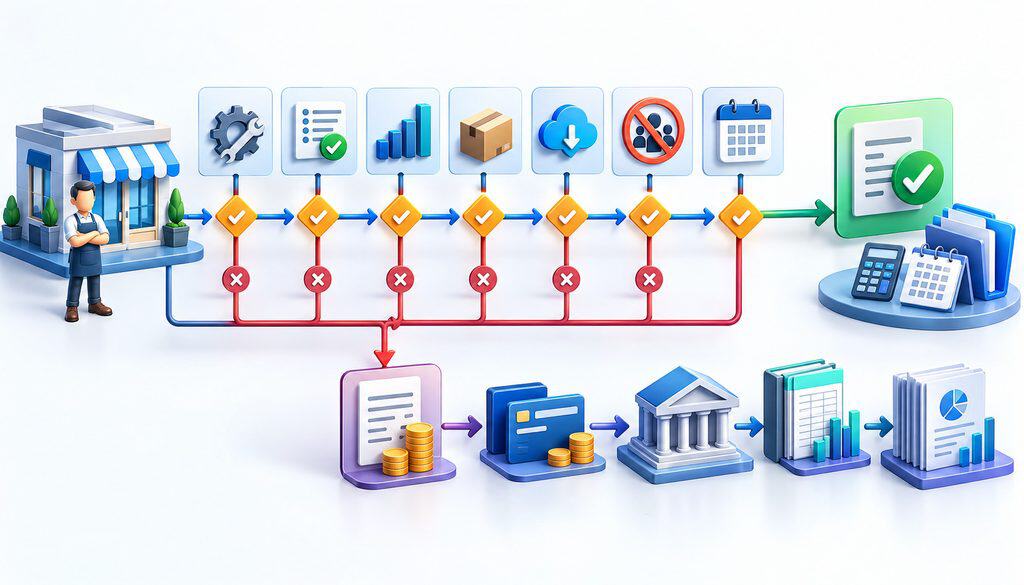
The current $12,000 rule is not a universal small-business exemption. KRS 139.470(23)–(24) applies to specified services in KRS 139.200(2)(g) through (ax), subject to conditions.
For a qualifying seller, DOR explains that the first $12,000 of covered service receipts can remain exempt until the threshold is crossed. In the first calendar year receipts exceed $12,000, receipts over $12,000 become taxable; once the seller crosses the threshold, all covered receipts are taxable in subsequent calendar years.
The exemption does not apply to a person also selling tangible personal property, digital property, or services in KRS 139.200(2)(a)–(f).
Hypothetical: A qualifying service-only freelancer in the applicable statutory category has $9,000 of receipts during the relevant first qualifying calendar year and no disqualifying sales. Those receipts can fall within the exemption.
If receipts later reach $14,000 in the threshold-crossing year, the statute does not retroactively tax the first $12,000; the $2,000 above the threshold is taxable, and later calendar years are treated under the post-threshold rule.
A particularly important 2026 detail is that current subsections (23) and (24) still reference (g) through (ax). Data brokering is now paragraph (ay). On the face of the current statute, the $12,000 exemption therefore does not extend to the new data-brokering category.
“Residential” Does Not Automatically Mean Sales-Tax Exempt
Selling to a homeowner does not make an otherwise taxable service exempt. Residential cleaning and landscaping, for example, are expressly within KRS 139.200.
The major residential rule associated with HB 8 concerns utilities: KRS 139.470(7) exempts qualifying sewer services, water and fuel used by a Kentucky resident at the resident’s place of domicile. That rule should not be generalized to cleaning, landscaping, fitness training or other taxable consumer services.
Other exemptions are purchaser- or use-specific. Kentucky provides rules for qualifying governmental purchases, certain nonprofit institutions and qualifying manufacturing activities. Sellers should obtain and retain the required exemption documentation instead of removing tax merely because a customer says, “We’re exempt.”
Sales for Resale
A taxable service may sometimes be purchased for resale rather than consumed by the purchaser. For example, a web-design company may subcontract a portion of a taxable website-design service that it genuinely resells to its customer.
Kentucky’s certificate rules matter: the reseller should provide the appropriate completed resale documentation and the seller must retain it.
How to Tell If Your Specific Service Is Taxable
Use this order instead of relying on your business name or NAICS code:
- Write down exactly what the customer buys.
- Temporarily ignore the company’s marketing label.
- Search current KRS 139.200 for the service.
- Check KRS 139.010 for a statutory definition.
- Read every exclusion attached to that category.
- Check KRS 139.470 and other applicable exemptions.
- Review current Kentucky administrative regulations.
- Search current DOR guidance and Administrative Writings.
- Identify multiple services or bundled components.
- Identify tangible or digital property sold with the service.
- Verify resale or exemption documentation.
- Obtain DOR or Kentucky SALT advice when the classification remains genuinely ambiguous.
A NAICS code can help describe an industry, but it is not a substitute for the statutory test unless Kentucky law specifically incorporates the classification.
What If One Invoice Contains Taxable and Nontaxable Work?
Kentucky’s bundled-transaction statute can make an entire nonitemized charge taxable when distinct taxable and exempt service products are sold together for one price, subject to statutory exceptions. KRS 139.215 also treats separately identified prices on documents such as an invoice, receipt, contract or service agreement differently from a single nonitemized price.
That makes real contract and invoice separation important for combinations such as marketing strategy plus website development or custom programming plus hosting. But merely creating two invoice lines does not make a taxable service nontaxable; the underlying activities must genuinely qualify for their stated treatment.
Kentucky One Stop Sales Tax Registration: Use MyTaxes Now

Kentucky One Stop is no longer the sales-tax filing portal. Sales & Use Tax transitioned to MyTaxes on March 14, 2025. Current DOR material says prior OneStop sales-tax accounts were migrated to MyTaxes.
| Task | Current system | Important note |
| Establish a business entity | Secretary of State/current business-registration process | Business One Stop may still have non-tax business functions |
| Register Kentucky tax accounts | MyTaxes/current DOR registration | Use the Kentucky Tax Registration Application process |
| File Sales & Use Tax returns | MyTaxes | OneStop tax filing is obsolete |
| Pay Sales & Use Tax | MyTaxes/current DOR method | Online mandate generally applies |
| Access migrated tax account | MyTaxes | Existing OneStop users should use the migrated system |
How to Register for a Kentucky Sales and Use Tax Account
DOR currently directs new businesses to register tax accounts through MyTaxes. Its Kentucky Tax Registration Application covers the Sales and Use Tax Account/Permit.
- Confirm that you are making taxable Kentucky sales and do not qualify for an applicable exemption.
- Gather the legal business name, entity and responsible-party information.
- Obtain the FEIN or other required taxpayer identification information.
- Create or access the MyTaxes portal account.
- Choose the new-business/tax-registration process.
- Add the Sales and Use Tax account when required.
- Enter the business locations and taxable-activity information requested.
- Confirm the account and assigned filing requirements.
- Build the tax code into accounting, invoicing and POS software.
- Begin collecting on the legally applicable date and calendar the return deadlines.
How to Add Kentucky Sales Tax to Service Invoices
For a Kentucky service business, 6 percent applies to taxable gross receipts, not automatically to every line the business bills.
Formula: taxable gross receipts × 6% = sales tax.
Hypothetical taxable invoice
Website development: $2,000
Kentucky sales tax: $120
Customer total: $2,120
For a mixed invoice, separately identify genuinely different activities—for example, website development and separately contracted general strategy consulting—using the tax treatment actually supported by law.
Kentucky requires retailers to display the tax separately on the sales receipt or other evidence of sale, subject to limited statutory exceptions.
What Happens When the Customer Pays by Card?
The sales tax becomes part of the amount the customer pays, but the payment processor does not decide whether your service is legally taxable.
Your invoicing, ecommerce or POS system needs the correct classification and tax rate, and businesses using an integrated checkout should make sure their POS and payment setup can consistently apply the correct transaction rules across in-person, mobile, and service-business payments.
For bookkeeping, a $2,120 card charge from the example above is not $2,120 of revenue:
- service revenue: $2,000;
- sales-tax liability: $120;
- processor fee: separately recorded under the merchant’s accounting policy;
- bank settlement: may be net of processing fees.
KRS 139.210 treats collected tax as a debt to the Commonwealth, reinforcing why collected tax should sit in a liability account instead of being booked as sales revenue.
Recurring Service Invoices Need the Same Tax Logic
Monthly website hosting, security monitoring, qualifying SaaS and recurring cleaning need the same classification logic on every billing cycle. Configure the tax code, effective date, exemption status, credits and refunds rather than assuming an old subscription remains permanently under its original treatment.
There is a narrow historical rule in KRS 139.202 for specified fixed-fee contracts and leases entered into on or before February 25, 2022. It is not a general grandfather rule for modern contracts.
Filing and Paying Kentucky Sales Tax
Kentucky’s current calendars show regular monthly returns due on the 20th of the following month; quarterly periods generally end with April 20, July 20, October 20 and January 20 due dates, and annual sales-tax returns are generally due January 20. When a due date falls on a state holiday or weekend, DOR moves it to the next working day.
DOR may assign or authorize different filing frequencies, and current 103 KAR 25:131 imposes accelerated payment requirements on qualifying larger taxpayers. Check the frequency actually assigned to your account.
Kentucky also generally mandates online sales-tax filing and payment when the electronic functionality is available, with limited waiver rules for qualifying circumstances. Registered sellers should continue filing required returns—including zero-activity periods—until DOR changes or closes the filing obligation.
What If You Never Started Collecting the Tax?
Do not apply today’s law mechanically to every earlier year. Historical cleanup should test each period under the law that applied then.
- Identify the exact service sold.
- Determine when that service became taxable.
- Account for HB 360 and later amendments.
- Test the de minimis rule applicable to each year.
- Reconstruct Kentucky taxable receipts by period.
- Identify tax that was actually collected.
- Calculate uncollected exposure.
- Identify missing or incorrect returns.
- Apply the penalty and interest rules for each period.
- Evaluate late or amended filings.
- Consider DOR or tax-counsel assistance for material exposure.
- Correct billing prospectively.
The current $12,000 threshold became effective in 2025; it should not simply be applied backward to 2023 transactions.
Penalties, Interest and Assessment Periods
Kentucky’s Uniform Civil Penalty Act generally provides a late-filing penalty of 2% of tax due for each 30 days or fraction, up to 20%, subject to the statutory minimum. Failure to collect or timely pay also generally carries 2% per 30 days or fraction, up to 20%. Failure to file can trigger a different 5%-per-period penalty, up to 50%, with its own minimum.
DOR lists the 2026 tax-liability interest rate at 9%, but historical liabilities use the statutory rate applicable to the respective year. Penalties may qualify for reasonable-cause relief; statutory interest generally cannot be waived.
KRS 139.620 generally gives DOR four years from the filing of a return to assess additional sales tax. If no return was filed, or the return was fraudulent, the statute permits assessment at any time. That is why “Kentucky has a three-year lookback” is not a safe assumption.
Kentucky’s 2024 tax-amnesty period ended November 29, 2024. DOR currently maintains a separate Voluntary Disclosure Program for qualifying taxpayers that approach the department before DOR contact; the program can provide a limited filing period and penalty waiver, but it has eligibility restrictions and does not cover a taxpayer that filed a return but merely underreported tax.
Remote Service Sellers: Taxability and Nexus Are Separate Questions
An out-of-state provider must first determine whether its service is taxable and then determine whether it has a Kentucky collection obligation.
Effective August 1, 2026, current KRS 139.340 uses a sales-volume economic-nexus threshold for remote retailers: Kentucky gross receipts exceeding $100,000 in the previous or current calendar year. The 2026 legislation removed the former transaction-count test.
For sourcing, KRS 139.105 generally looks first to where the purchaser receives the service, then uses statutory address rules when that location is unknown. Do not automatically assume seller address, employee work location or billing address always controls.
Six Quick Examples
- Kentucky web developer: Website design and hosting are both specifically taxable.
- CPA firm: Ordinary accounting remains a nontaxable service, but a separately sold transaction could require its own classification.
- Residential cleaner: Homeowner status does not exempt residential cleaning.
- Qualifying freelancer: A covered service-only seller may qualify for the narrow $12,000 rule; other taxable sales can disqualify the seller.
- SaaS provider: Subscription access to qualifying prewritten software is taxable; genuinely custom software requires a separate analysis.
- Marketing agency: Standalone marketing was removed from the taxable list, but website development or hosting sold by the same agency remains taxable.
Common Misconceptions
| Myth | Reality |
| Kentucky taxes every service now. | Only enumerated services and other statutorily taxable transactions are taxed. |
| Freelancers never collect sales tax. | Business form does not determine service taxability. |
| My NAICS code decides the answer. | Actual statutory classification controls. |
| Marketing and website design are taxed alike. | Marketing was removed; website design remains taxable. |
| Every business gets $12,000 tax-free. | The exemption has category and seller restrictions. |
| Staying under $12,000 means never checking again. | Eligibility and business activities must continue to be monitored. |
| Residential customers are exempt. | Many taxable services remain taxable when sold to homeowners. |
| Kentucky One Stop still files sales tax. | Sales & Use moved to MyTaxes in March 2025. |
| My processor handles tax compliance. | The merchant must determine legal taxability. |
| Kentucky cannot assess tax I never collected. | Unfiled-return assessment rules can remain open. |
| Sales tax collected is revenue. | It is a tax liability owed to Kentucky. |
Common Service-Business Tax Mistakes
| Mistake | Why it causes problems | Better control |
| Using an old HB 8 list | Later laws changed categories | Check current KRS 139.200 |
| Taxing by business label | One company can sell several service types | Classify invoice lines |
| Treating all consulting alike | Some activities may actually be enumerated | Document the actual deliverable |
| Applying $12,000 broadly | Seller/category restrictions can disqualify it | Test KRS 139.470(23)-(24) |
| Assuming homeowner = exempt | Cleaning/landscaping can remain taxable | Check service, not customer label |
| Using old OneStop instructions | Portal changed | Use MyTaxes |
| Recording tax as revenue | Overstates revenue and hides liability | Use sales-tax payable account |
| Ignoring old periods | Current compliance does not erase prior exposure | Perform period-by-period cleanup |
How to Start Collecting Kentucky Sales Tax
- Inventory every service and product sold.
- Map each service to current KRS 139.200.
- Check definitions and exclusions.
- Identify customer/use exemptions.
- Test the $12,000 rule where eligible.
- Confirm Kentucky nexus and sourcing.
- Register the appropriate tax account.
- Set up MyTaxes access.
- Confirm filing frequency.
- Create taxable and nontaxable accounting codes.
- Configure invoice tax rules.
- Configure recurring billing.
- Configure POS/card-payment tax handling.
- Store exemption/resale certificates.
- Test refunds and credit memos.
- Reconcile tax monthly.
- File and pay by the assigned deadline.
- Recheck classifications after legislative changes.
Useful internal tax codes might be KY-TAXABLE-SERVICE, KY-NONTAXABLE-SERVICE, and KY-EXEMPT-CUSTOMER. Those names are bookkeeping conventions, not legally required Kentucky codes.
For monthly reconciliation, compare taxable sales, exempt/nontaxable sales, tax collected, refunds/credits, the filed return, the MyTaxes payment and the remaining sales-tax-liability balance.
Processor deposits alone are a poor substitute because fees, refunds, chargebacks, and settlement timing can separate bank deposits from gross transaction activity; a consistent process for reconciling processor reports with accounting and bank records helps finance teams identify those differences before preparing sales-tax records.
[Expert Quote Placeholder]
Insert a verified quote from a Kentucky CPA, SALT professional, or tax attorney explaining why the actual service sold must be classified rather than relying only on an industry label.
Frequently Asked Questions
What services are subject to Kentucky sales tax?
Kentucky taxes services specifically enumerated in KRS 139.200, including landscaping, janitorial work, photography, website development and hosting, fitness training, specified security services, prewritten software access and many others.
Data brokering joined the list effective August 1, 2026. Always check the current statute because the list has changed several times.
Is every service taxable in Kentucky now?
No. Kentucky does not impose a general tax on every service. Ordinary accounting, legal and many other professional activities remain outside the enumerated list, although the same business can make separate taxable sales. The transaction actually sold—not simply the profession of the seller—determines the starting point.
What did HB 8 change for service businesses?
The 2022 HB 8 legislation greatly expanded Kentucky’s taxable-service base beginning January 1, 2023. DOR says more than 30 additional service categories became subject to tax through HB 8 and related changes. HB 360 and later legislation then modified the rules, so the original HB 8 list should not be treated as current law.
Is there still a small-business exemption for taxable services?
There is a limited exemption for qualifying sellers of services within the statutory paragraph range in KRS 139.470(23)–(24). It is not available to every small business and can be unavailable when the seller also makes specified property, digital-property or other taxable-service sales.
What is Kentucky’s current de minimis threshold for taxable services?
The current covered-service threshold is $12,000. In the year a qualifying seller first exceeds it, DOR states that the receipts above $12,000 become taxable; once crossed, subsequent calendar-year receipts are taxable. Data brokering sits in paragraph (ay), while the current exemption references only (g) through (ax).
Do I still register through Kentucky One Stop?
Not for the current Sales & Use Tax workflow. Kentucky moved Sales & Use Tax to MyTaxes on March 14, 2025. New tax-account registrations can be completed through MyTaxes using DOR’s current Kentucky Tax Registration Application process. Business-entity formation and other state registrations are separate matters.
How do I add Kentucky sales tax to an invoice?
First determine which invoice lines are legally taxable. Multiply those taxable gross receipts by 6%, separately display the Kentucky tax on the customer’s receipt, and book the tax to a sales-tax-liability account. Do not simply apply 6% to every service line because one customer invoice can contain both taxable and nontaxable activities.
Do residential customers pay sales tax on taxable services?
Yes, when the service itself is taxable and no other exemption applies. Kentucky expressly includes residential cleaning within janitorial services, for example. The residential utility exemption for qualifying sewer, water and fuel at a Kentucky resident’s domicile is a separate rule and does not create a general homeowner exemption.
What should I do if I should have collected Kentucky sales tax in prior years?
Reconstruct the service, taxability, exemption eligibility and receipts separately for each historical period. Determine missing returns and tax, apply the penalty and interest provisions for those periods, and evaluate late filings or Kentucky’s current Voluntary Disclosure Program when its eligibility rules fit. Do not simply start collecting now and assume earlier periods disappear.
Check the Service First, Then Build the 6% Tax Into Your Workflow
The practical rule for Kentucky sales tax on services starts with classification. Kentucky taxes specifically enumerated services, and the current statute matters more than an old HB 8 checklist.
After identifying a taxable service, separately test exclusions, customer exemptions and the narrow $12,000 rule. Then register through the current DOR/MyTaxes process and build the correct treatment into invoices, subscriptions, card payments and accounting.
Finally, reconcile tax consistently and revisit classifications after legislative changes. If an older period was handled incorrectly, analyze it using the law that actually applied during that period rather than applying the 2026 rules retroactively.
Leave a Reply